Business identity
Name, category, phone, service area, and website destination should provide a coherent public identity. The report notes observed differences and the source timestamp.
A Google Business Profile can introduce the business, provide public trust signals, and route the prospect toward a call, website, or other action. The audit evaluates that public entry surface together with the destination journey.
Record the publicly displayed business name, primary category, service area, hours, phone number, website destination, and visible service information. Compare these fields with the website without assuming that every difference is incorrect. Material inconsistencies become customer-verification items unless another authoritative public source resolves them.
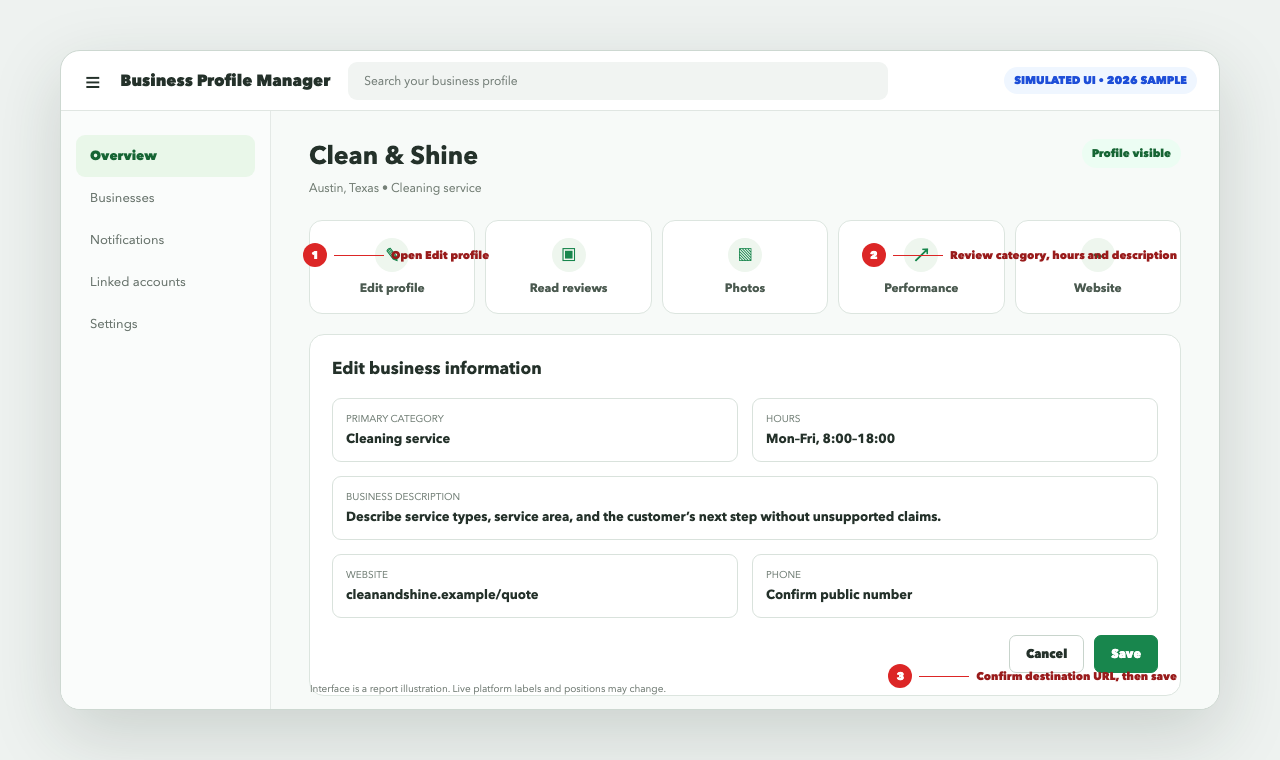
Name, category, phone, service area, and website destination should provide a coherent public identity. The report notes observed differences and the source timestamp.
Visible services should help a residential customer distinguish the cleaning scope. Unsupported keyword repetition is not treated as a substitute for useful service information.
Rating, volume, recency, owner responses, and recurring customer themes may provide context. The audit does not infer causation or private lead impact from review data alone.
Current, representative photos can reduce uncertainty about the business and service. Stock-like imagery or stale public media is documented carefully, without claiming ownership or intent.
Call, website, direction, message, or booking actions are reviewed for relevance and destination continuity. Availability can vary by device, location, and platform state.
The landing page should preserve the expected service, location, identity, and next action. A strong profile cannot compensate for a confusing or broken destination path.
Profile data is volatile. A defensible report records the source URL or public identifier, capture time, observed value, and any access limitation. If a field cannot be confirmed, it is labelled not observed or requires customer verification. The analysis should not invent competitors, review counts, categories, or ranking positions when the source cannot be captured.
LeadAuditLab is not affiliated with Google and does not treat any single platform as the sole source of demand. Relevant public entry points may also include directories, social profiles, marketplace listings, and the business website, subject to source permission and evidence sufficiency.
The strongest initial recommendations usually address material identity conflicts, broken actions, missing service-area context, or a poor website handoff. Lower-impact profile refinements can follow after the customer can reliably move from discovery to a qualified inquiry.
The complimentary diagnostic shows three business-specific public-journey findings and one annotated evidence view.