Destination clarity
Does the next page preserve business identity, service context, and the reason the customer should continue?
Do not begin by assuming the website, traffic source, or sales process is solely responsible. Separate visibility, inquiry-path continuity, and follow-up performance, then test the first observable point of friction.
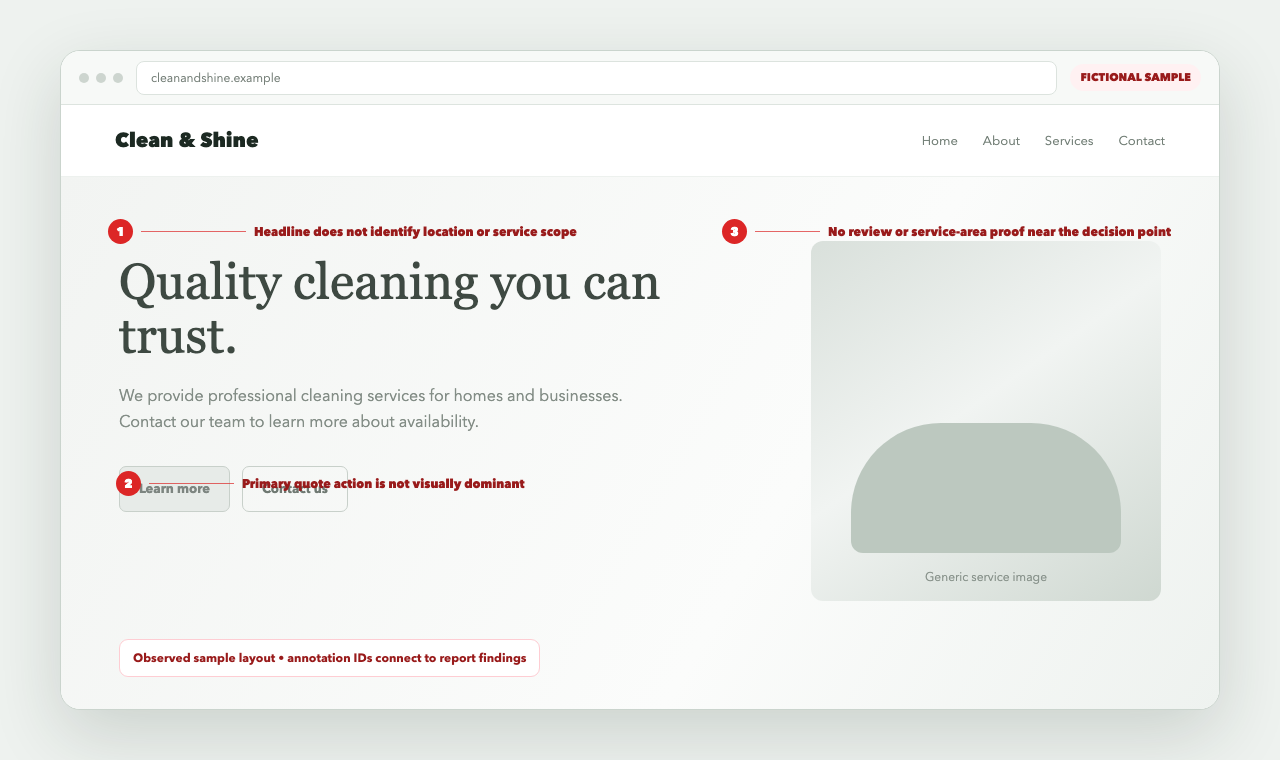
A visitor should be able to determine the service category, applicable city or service area, and primary next action without interpreting broad promotional language. For residential cleaning, the opening message should distinguish relevant services and present a commercially precise action such as requesting a quote or checking availability.
A prominent button is not sufficient if its destination is ambiguous, inaccessible, excessively demanding, or silent after submission. Test the journey from the homepage through the final confirmation state on a real phone and record each transition.
Does the next page preserve business identity, service context, and the reason the customer should continue?
Does every required field support eligibility, scope, scheduling, pricing context, or communication?
Where appropriate, is a traceable phone or contact route available without competing with the primary action?
After submission, does the customer receive a clear acknowledgement and a realistic next-step expectation?
Reputation and assurance content should support the inquiry decision, not merely decorate the page. Review whether current business identity, traceable reviews, service examples, accurately bounded guarantees, insurance statements, and privacy context appear close to the quote action. Merchant-published claims should be labelled as such unless independently verified.
A public review can establish what a prospective customer could observe at the time of capture. It cannot establish traffic volume, form abandonment, channel attribution, close rate, or revenue impact without authorized private data. Use analytics, call records, form events, and the quote log to test whether the observed condition corresponds with actual customer behavior.
Record qualified visits, phone calls, form submissions, first-response time, quotes issued, and bookings. Change one material element at a time, retain the baseline, and compare the same measurement window. Treat movement as evidence for further testing rather than proof of universal causation.
The complimentary three-point diagnostic is designed to establish whether a business-specific public finding is sufficiently clear and useful before purchase. The Starter Report extends the governed scope to five findings, five recommendations, the score register, and retained evidence.
Available for eligible United States residential-cleaning websites with sufficient public evidence.